Older readers may remember the John Denver hit, "Some Days Are Diamonds", the lyrics of which go on to say, "... some days are stone". He was responding to a query about how he was feeling since his true love and he had parted company. I guess you are wondering where this is headed. Bear with me.
The lyrics to Denver's classic have famously been misheard as, "Some days are diamonds, some days are pearls..." being similar sentiment to the publicity line for Tourism Queensland (Beautiful one day, perfect the next). In reflecting on our time in Padua, I prefer to quote the mondegreen (the line about the pearls). It has been absolutely wonderful; perhaps some days even more wonderful than others.
See, I told you I would get there.
Tomorrow morning, clutching our pre-purchased train ticket, we will make our way to the stazione and board the train for our next destination, Orvieto, in the region of Italy called Umbria. This region is known locally as "the green heart of Italy"; it is the only land-locked region and is famous for its emerald sloped mountains, rolling green hills, forests, tumbling rivers and lush farming land. It will be quite different from the Veneto region, of which Padua is a main city.
We will bid farewell tomorrow to the superb Giotto frescoes of the Scrovegni Chapel, the magnificent Basilica of St Anthony, the tranquil botanical gardens, the fresh food markets, the huge expanse of public space known as the Prato, the beautiful duomo, the coffee shops, the pastries, the wonderful sunlit piazzas and the stunning arched walkways.
We will also say goodbye (though not personally) to the tuxedo-dressed grand piano player, the old guy with the trumpet who plays "My Way" and "Hava Nagila" in a continuous loop, the chap with the piano-accordion who works his way around town, the 3-piece band of cellist, violinist and double-bassist and the fellow with the worn-out three-stringed guitar who plays and sings all day with his eyes closed.
We will say one last firm, "No, grazie!" to the Senegalese guys selling handbags, cigarette lighters, packets of tissues, umbrellas, and watches and pass by the balloon man, the fire-juggler and the Charlie Chaplin statue impersonator, and we will walk right through the massive end-of-Autumn fare taking place today in the Prato towards today's other highlight, the Chestnut Carnival (hot roasted chestnuts and mulled wine included). We will sit there with a glass of something and a plate of something, reflecting on all the things we will miss, then we will head back to the apartment to pack our bags in readiness for our early-morning departure.
I don't know how stable the internet connection will be, in Orvieto, so there may be a delay before you hear from us again (or not...).
D1
Showing posts with label Padua. Show all posts
Showing posts with label Padua. Show all posts
Sunday, 6 November 2011

Sunday, 30 October 2011
Vicenza
I had decided some time ago that I wanted to visit Vicenza, a city about 30 minutes by train east of Padua, and the capital city of the Veneto region. The city is mostly well-known for the number of buildings which are attributed to the architect, Palladio, who was busy during the last half of the 16th century - so well known in fact that the entire city has been declared a UNESCO World Heritage site. Palladio, who died in 1580, is best known for his final work, the Teatro Olimpico, which was not completed until 1595. The beauty of the interior, the design and construction of the stage settings, and the fact that the original wooden seats are still in use, make this a very special building.

Vicenza is rich with other fine examples of Palladio's work, mostly palazzos that have been purchased by banks, fashion brands and very rich individuals. It is also one of the few cities visited on this trip that has some area devoted to parks and gardens and that makes for a nice change.

This weekend also sees the end of Daylight Saving for most of Europe, and despite the continuance of bright sunny days, the light is now fading at 4:30 in the afternoon, and there is starting to be a little chill in the air at night.
D2

 |
| The stage is designed to look like a Piazza with streets leading on to it |
 |
| The elliptical design of the seats allows patrons to sit almost on top of the stage area |
 | |
| The depth of the stage is enhanced by the design and contruction of the scenery |

This weekend also sees the end of Daylight Saving for most of Europe, and despite the continuance of bright sunny days, the light is now fading at 4:30 in the afternoon, and there is starting to be a little chill in the air at night.
D2
Friday, 28 October 2011
Bologna for Lunch
The heading is not about the world famous sausage or the sauce (bolognese), both of which derive their names from the Italian city of Bologna.
We had decided to go to Bologna for lunch, a journey which takes about an hour an a half on the train. A booking had been made at Da Cesari, and upon arrival, we were not disappointed. I started with a delicious pumpkin ravioli which was cooked in a burnt butter sauce - simply delicious, while Debbie had a small flan made from locally grown mushrooms. Main courses were sea bass for me and lasagne for Debbie, again both courses beautifully cooked and presented. There was of course the home-made bread and olive oil, and an excellent bottle of Pinot Grigio followed by Zuppa Inglese and Crema Caramel then coffee and tea served with a very generous complimentary plate of three home-made sweet bites: tiny melt-in-the-mouth meringues, coffee-crusted sultanas and slabs of pistacchio brittle. The wonderful food, the ambience created by the restaurant's decor, the subtle background music and the highly efficient staff all contributed to a really great experience and made the trip to Bologna well worth the journey.

Bologna is one of the larger cities in Italy with a total urban population in excess of one million people, and it is also home to the oldest university in the world which was founded in 1088. The city is known for its kilometres of portici, or covered terracotta arcades, numerous churches of all shapes and sizes, a score of palazzos, piazzas and all the high end shops you can think of.

The entry to the centre of the city is along Via Dell'Indipendenza which leads to the Piazza Maggiore where the Basilica Di S. Petronio stands at one end of the piazza (all covered in scaffolding and sailcloth and no photos allowed) whilst on either side there are the Palazzo Re Enzo and Palazzo D'Accursio. Along the way there is the impressive statue of Garabaldi sitting astride his horse in the Piazza VIII Agosto.

The Cattedrale Di S. Pietro just prior to arriving in Piazza Maggiore was very impressive, albeit relatively new in Italian terms, dating from 1575 when the main chapel was built, and completed in 1605.

Another small church discovered along the way was Chiesa San Benedetto, which despite its beauty, doen't even rate a mention in the official guide book to Bologna, such is the plentiful nature of churches and other places of worship.
The only disappointment on the day was that the famous Fontana Del Nettuno stood forlorn in the Piazza Maggiore as dry as a chip. This fountain is considered by some to be the second most significant fountain in all of Italy (after the Trevi Fountain in Rome) and to see poor old Neptune standing there with all his parts exposed and without the opportunity of a cleansing shower left a bit to be desired.

D2
We had decided to go to Bologna for lunch, a journey which takes about an hour an a half on the train. A booking had been made at Da Cesari, and upon arrival, we were not disappointed. I started with a delicious pumpkin ravioli which was cooked in a burnt butter sauce - simply delicious, while Debbie had a small flan made from locally grown mushrooms. Main courses were sea bass for me and lasagne for Debbie, again both courses beautifully cooked and presented. There was of course the home-made bread and olive oil, and an excellent bottle of Pinot Grigio followed by Zuppa Inglese and Crema Caramel then coffee and tea served with a very generous complimentary plate of three home-made sweet bites: tiny melt-in-the-mouth meringues, coffee-crusted sultanas and slabs of pistacchio brittle. The wonderful food, the ambience created by the restaurant's decor, the subtle background music and the highly efficient staff all contributed to a really great experience and made the trip to Bologna well worth the journey.

Bologna is one of the larger cities in Italy with a total urban population in excess of one million people, and it is also home to the oldest university in the world which was founded in 1088. The city is known for its kilometres of portici, or covered terracotta arcades, numerous churches of all shapes and sizes, a score of palazzos, piazzas and all the high end shops you can think of.

The entry to the centre of the city is along Via Dell'Indipendenza which leads to the Piazza Maggiore where the Basilica Di S. Petronio stands at one end of the piazza (all covered in scaffolding and sailcloth and no photos allowed) whilst on either side there are the Palazzo Re Enzo and Palazzo D'Accursio. Along the way there is the impressive statue of Garabaldi sitting astride his horse in the Piazza VIII Agosto.

 | ||
| Piazza Maggiore (built in XIII century) as seen from the top of the scaffolding on the Basilica Di S. Petronio |

Another small church discovered along the way was Chiesa San Benedetto, which despite its beauty, doen't even rate a mention in the official guide book to Bologna, such is the plentiful nature of churches and other places of worship.
 |
| Chiesa San Benedetto |

D2
Sunday, 23 October 2011
Sunday in Padua
The shops are all closed and the streets are quiet, and yet every public space has an activity of some sort to engage the community. In one, there is a stage set up for a trio of musicians to belt out tunes to an appreciative audience; in another there is a line of tents offering samples of local produce including cheeses, preserves, salami and even bowls of hot risotto! A further square has been set aside for a parade of old cars, proudly driven through by their owners, each with a pretty Italian maiden in the front passenger seat, all dressed-up and ready to be photographed when they reach the other side and she positions herself alluringly beside the bonnet. Every piazza is a little hive of activity and we repeatedly question what Robert Doyle (Melbourne's Lord Mayor) would make of it all. We suspect such fun could never be had at home in the Nanny State.
D1 (text) & D2 (photos)
 |
| No bikes, no vehicles and no people - all very peaceful |
 |
| Via Belludi with Basilica di Sant'Antonio da Padova straight ahead. The basilica was begun in about 1230 and completed the following century. The bones of the saint lie in a marble-decorated chapel here. |
 |
| A grand piano has been rolled out to entertain in Piazza Cavour - old and young gather to listen. Cyclists stop and lean against their bikes, paying full attention, then mounting again and riding off. |
 |
| Sculpture exhibition - this is in a former piazza which has been covered over with a glass roof and now houses a multi-storey gallery for artists of all kinds. The architects have maintained the ancient columns and curved arches of the original area, but given it a new lease of life by converting it into this light, spacious public room. |
 |
| An unexpected find - Chiesa di S. Gaetano - an absolutely magnificent church with an absolutely ordinary facade. |
 |
| Arched colonnades - a feature of Paduan streets. |
 | |||||||
| Chestnuts cooking in Piazza di Signori. It is currently chestnut season and in most piazzas there is someone roasting them over an open fire, and everywhere there are people walking about with paper bags of hot chestnuts they are juggling from hand to hand while munching. This fellow was charging five euros for 300g. That's about AUD$6.70 |
D1 (text) & D2 (photos)
Saturday, 22 October 2011
@#&@#&# trains, long lunches and a trip to Treviso
The plan was fairly simple: catch the 9:29 am train from Padua to Mestre, change trains for Treviso, and be there by 10:15 am, allowing plenty of time to have a good look around, have some lunch, shop a little and then have a leisurely train trip home in the late afternoon.
Trenitalia had a different plan. The train left Padua on time, the sky was blue, there were plenty of seats available and plenty of time to make the connection in Mestre. Then the wheels fell off. The train from Mestre to Treviso didn't arrive for some reason unknown to us, and when a train destined for Treviso did arrive, it sat there not going anywhere until a train from some other destination arrived, disgorging hoardes of people, most of whom jumped on our train, and one minute later we left for Treviso, finally arriving at around 11:30 am.
After following some misdirections from a Macedonian waiter, delivered in German, we finally found the Informazione Touristiche and secured ourselves a mappa, went back to the Macedonian waiter and rewarded him by ordering coffee and brioche and then headed into the depths of the town only to discover that it was now lunchtime. Lunchtime in Italy can last from about 12:30 to 4:00 pm depending entirely on the hours which individual shopkeepers and businesses choose to operate within - the churches and Duomo were listed as having a respectful lunch break from 12:30 until 3:30 pm, the small shops from 1:00 until 4:00 pm but the market stallholders were all gone by 1:00 o'clock and they weren't coming back at all. The cafes, bars and restaurants stay open and make a killing.
So, what to do? Have lunch of course, and visit the natural attractions and historical buildings that don't require a staff member to attend to you or sell you a ticket of some kind. That's when you discover that almost every noteworthy building or historical sight is covered in scaffolding and sailcloth to indicate that restorations are underway. Mind you, not a single workman has been sighted so far.
So, as the clock clicked slowly around to 3:00 o'clock we devised a new plan - visit Chiese dei San Francesco, the Duomo, take in the shops on Via Calmaggiore and Piazza dei Signori and make a slow arc back to the station for the return trip to Padua. All is well.
Treviso is a small city (pop. 82,000) just north of Venice, and if the quality of the shops and the shopping can be used as a guide, it is a more affluent area than some others we have seen. The piazzas, streets and laneways, public spaces and buildings are all very beautiful, and it's a real shame that it is closed for so much of the time every day. Such is life in Italy.


We arrived back at the station in time for our train to Mestre, and then on to Padua. Only now we discover that there is a Trenitalia strike and no trains will run until after 5:00 o'clock, after which time, the tracks will be cleared and we will be on our way, first train out of the station. How do we know this? The conductor has boarded our train after we had sat motionless (the train, not us) for about 20 minutes at the station, made the announcement and made to leave. Deb springs into action and asks him to please repeat what he has just said in English. "Englese? No problema," he laughs, turning to a passenger sitting nearby and with just a shrug and upturned palms is clearly asking if the other guy can help out, which thankfully he does.
We finally get to Mestre, and it's a zoo. There are thousands of passengers, all stranded and all waiting for a train to somewhere, and nothing is either coming or going.
Needless to say, we arrived home very late, with the fairly simple plan for the day having not quite worked out.
D2
Thursday, 20 October 2011
La Finestra - The Window
The night before last we thought it was high time that we tried one of the local restaurants that we had heard about, called La Finestra. It's situated very close to our apartment (as is just about everything; we are very centrally located) so it is no problem to walk there in the evening. Like most Europeans, the Italians eat dinner quite late, generally after they have had a little drink and snack on the way home from work, with friends or colleagues (a very delightful institution, I might add). We had returned around 6:30pm from Venice and needed to rest a bit, freshen up and change clothes before we headed off, so it was about 8:30pm by the time we wandered in to La Finestra.
Thankfully, it was a quiet night and there was a table available without a reservation being necessary. Most Italians, I think it is true to say, eat their main meal at home unless they are celebrating a special occasion or perhaps on a Sunday at lunchtime, when they might go to a restaurant with family. Consequently, restaurants are quite dependent on the tourist trade or at least on visitors from out of town. As we've mentioned before, Padua is not really on the tourist trail, an enormously favourable feature of the town as far as we are concerned, so we don't see here the kind of traffic of other places, and we are not constantly fighting the kind of touting that we have experienced in larger cities where restaurant owners try to coax you into their establishments as you pass by, and offer menus which contain dishes which tourists expect to find.
La Finestra is a small family-owned establishment, run by a husband and wife who really know their stuff. The table linen was of a beautiful embossed fabric, the crockery, glassware and cutlery of the highest quality and the service exemplary. The walls are interestingly decorated with take-offs of Magritte paintings, not presented in regular frames but in window frames, so that it appears you are looking through a window to these weird and wonderful visions outside. Quirky touch. I liked it a lot.
More to the point, the food was AMAZING. My entree was simply called "chicken salad" on the menu but turned out to be tiny jewels of chopped glace fruits, roasted pinenuts, moist morsels of diced chicken, baby green leaves of some description on a bed of wafer-thin scrapings of beetroot. It was absolutely divine. This photo does not do it justice, but I'm including it anyway:


Our hostess, Helene, was very interested in learning about why we were in Padua and shared with us some interesting insights into her hometown. She was really good company and we enjoyed chatting with her and thought it added to our evening in a way that you don't usually expect when dining in a restaurant. She even introduced us to the chef, her husband, whom we were quick to shower with praise about our delicious meals. The evening finished with a complimentary digestif of rosemary, lemongrass and "serious" alcohol. It was clearly a "home brew" and an unusual but delicious combination of flavours.
So, hence consequently therefore (as a dear departed friend used to say), if you are ever in Padua, don't even think about eating anywhere else.
D1
Thankfully, it was a quiet night and there was a table available without a reservation being necessary. Most Italians, I think it is true to say, eat their main meal at home unless they are celebrating a special occasion or perhaps on a Sunday at lunchtime, when they might go to a restaurant with family. Consequently, restaurants are quite dependent on the tourist trade or at least on visitors from out of town. As we've mentioned before, Padua is not really on the tourist trail, an enormously favourable feature of the town as far as we are concerned, so we don't see here the kind of traffic of other places, and we are not constantly fighting the kind of touting that we have experienced in larger cities where restaurant owners try to coax you into their establishments as you pass by, and offer menus which contain dishes which tourists expect to find.
La Finestra is a small family-owned establishment, run by a husband and wife who really know their stuff. The table linen was of a beautiful embossed fabric, the crockery, glassware and cutlery of the highest quality and the service exemplary. The walls are interestingly decorated with take-offs of Magritte paintings, not presented in regular frames but in window frames, so that it appears you are looking through a window to these weird and wonderful visions outside. Quirky touch. I liked it a lot.
More to the point, the food was AMAZING. My entree was simply called "chicken salad" on the menu but turned out to be tiny jewels of chopped glace fruits, roasted pinenuts, moist morsels of diced chicken, baby green leaves of some description on a bed of wafer-thin scrapings of beetroot. It was absolutely divine. This photo does not do it justice, but I'm including it anyway:

I had a pumpkin risotto for my main course. It was golden, sweet, flavoursome and delicious and I couldn't possibly finish it, firstly because of its richness and secondly because of the size of the serving.
Like most people I know that carob is used as a kind of chocolate substitute, usually eaten by people who can't tolerate chocolate. The dried carob bean, however, can be ground into flour and used in all sorts of savoury dishes which bear no relationship to chocolate at all. David chose "carob ravioli" as his starter and this (he said) was probably one of the best dishes he has eaten in a restaurant anywhere in the world (high praise, no?). The ravioli parcels were light and delicate, filled with soft ricotta and served with (wait for it...) a potato sauce. Now that doesn't even sound appealing, does it? It was, however, wonderful. I know, because I tried it.
David's main course was fresh grilled tuna served on a bed of caramelised onion and accompanied by roasted vegetables. He said it was exquisite. I believe him; it looked so. Once again, I include below a photo, but it doesn't do the dish justice.

Our hostess, Helene, was very interested in learning about why we were in Padua and shared with us some interesting insights into her hometown. She was really good company and we enjoyed chatting with her and thought it added to our evening in a way that you don't usually expect when dining in a restaurant. She even introduced us to the chef, her husband, whom we were quick to shower with praise about our delicious meals. The evening finished with a complimentary digestif of rosemary, lemongrass and "serious" alcohol. It was clearly a "home brew" and an unusual but delicious combination of flavours.
So, hence consequently therefore (as a dear departed friend used to say), if you are ever in Padua, don't even think about eating anywhere else.
D1
Wednesday, 19 October 2011
Bo Palace: Anatomical Theatre
Padua University is the second oldest university in Italy, and the various faculties and campuses can be found all over the city. Of particular interest is the Faculty of Medicine where the original Anatomical Theatre can still be found in the Bo Palace, and only viewed from beneath as the structure is no longer safe enough to bear the weight of too many people.
The theatre was the first of its kind in Europe and consists of six elliptical tiers made of wood, with standing room for 300 students, all able to look down at the surgical action on the anatomical table below. The use of human corpses for such study was banned by Catholic Law at the time, so these procedures were done under conditions of great secrecy, and usually at night by torchlight. If there was a sudden threat of being "raided" by the police or authorities, the surgical table was able to be rotated to cause the human corpse to be hidden, and an animal cadaver revealed in its place. When the students and the professor had no further use for the bodies, they were taken into an adjoining room where they were boiled until all the flesh was stripped from the bones, and in this way a new batch of students was able to study the human skeletal structure. All very interesting.
Padua University is also famous for the fact that the first woman in the world to obtain a university degree graduated from here and there is a statue of her in one of the darkened alcoves. Given that the University was founded in 1222, it is interesting to note that it was not until 1678 that this event took place.
No photography allowed - attached photo of the Anatomical Theatre lifted from the internet.
D2
Tuesday, 18 October 2011
The heat is on
The law in Italy says that home heating sytems can't be turned on until 1 November each year, and that the temperature cannot exceed 21 degrees celsius. Here in the north of the country, the local governments can apply for variations, which are usually granted, and so Padua is allowed to turn on the heat from 15 October. Now, as the evening temperatures begin to fall, we can walk through the door into a lovely warm room and feel a new level of comfort.
Sunday, 16 October 2011
The Past Few Days
We are acutely aware that we haven't blogged for a few days, but it's not because we can't be bothered or there's nothing to write about. In fact we are having a wonderful time, just relaxing and taking it all in, which was always our intention on this trip. We never intended to rush around "doing stuff", and that's the beauty of it.
In the mornings we get up around 8:00 or 9:00am and if we feel like it, we eat breakfast here in the apartment, which generally comprises cereal, toast and tea, but quite often we go to one of the nearby cafes called Brek, which is so ridiculously good that we repeatedly wonder why we ever have breakfast at home. One euro (about $AUD1.34) at Brek will buy you a wonderful coffee (any kind you like) and a pastry - this pastry comes served hot, freshly baked and you can choose either: a plain croissant, a flaky pastry filled with Nutella, a croissant filled with custard, a plain donut, jam-filled donut or custard-filled donut or a muffin. So, one euro = one coffee + one pastry. Does it get any better than that?

There's always something going on in Padua. We are happy to walk around the different market stalls every day and buy this and that while observing the "theatre".


Sometimes there will be a guy playing the piano accordian, or a juggler or a balloon artist. This morning there was a brass band - we don't know what the celebration was, but the uniform was interesting, featuring feathered hats and much pomp and ceremony.

Last Friday I went to see the synagogue here, hoping to just pop in for a moment, take a look around and then leave. I realised that it was Succoth, a special holy day in our calendar but I didn't think that would make a difference. An hour and a half later I emerged, having stayed for the whole service and been plied with sweet cake and wine, as well as being invited back to come again as often as I can. There were only 18 in the whole congregation but everyone was SO nice to me that I felt very welcome and included from the moment I arrived, when I was given a prayer book and shown which passage they were up to; it was all lovely. To travel to the other side of the world and find your own people waiting for you is very heartwarming.
We have been blessed with wonderful weather since arriving, with temperatures around 20 degrees each day as well as clear blue skies most of the time. It can be chilly in the evening but we came prepared for that and manage perfectly well with an extra jacket and scarf when we walk after dinner. Last night we walked to the piazza and bought gelati around 8:00pm but we came back to the apartment to eat it, as there was a bit of a cool breeze blowing and it was easier to just head back home. Most afternoons we sit in the piazza and have a glass of wine while doing some people-watching before we have dinner. There is quite a sport of that going on here, it seems. Many couples and small groups seem to do the same as we do, perhaps on their way home from work. There is a fellow roasting chestnuts in the piazza late each afternoon and we usually choose a spot where we can watch him throwing the huge pan in the air and chatting with everyone who walks by.

Today we made a day trip to a little town called Este, which is about 30 minutes away by train. It is an historical town with a castle, and every third Sunday there is an antique market in the piazza, so we thought that might be fun. It was OK, but not as good as we expected. It doesn't matter, though, because when you have a month to do things, there will be some days that are better than others. Here's the obligatory photo of the castle in Este, anyway:

Incidentally, for the first time today since our journey began, I heard the "f-word" and not just once but about 87 times. It wasn't an Italian saying it. A group of young Australian boys boarded our train, apparently on their way to watch a rugby game (?) in Verona. They were loud and obnoxious and every sentence was punctuated with swearing and carry-on. We were not proud.
Is it wrong to say that we're missing TV? We have about 300 stations on our TV but none of them is English-speaking. Sometimes in the evening you just want to sit down and watch a movie, a documentary or any old thing, but it's not possible. I'm grateful for having the Kindle with me, as I've read four books in the past two weeks and am nearly finished with my fifth.
OK, enough from me for now. Hope all is well, wherever you are reading this.
D1
In the mornings we get up around 8:00 or 9:00am and if we feel like it, we eat breakfast here in the apartment, which generally comprises cereal, toast and tea, but quite often we go to one of the nearby cafes called Brek, which is so ridiculously good that we repeatedly wonder why we ever have breakfast at home. One euro (about $AUD1.34) at Brek will buy you a wonderful coffee (any kind you like) and a pastry - this pastry comes served hot, freshly baked and you can choose either: a plain croissant, a flaky pastry filled with Nutella, a croissant filled with custard, a plain donut, jam-filled donut or custard-filled donut or a muffin. So, one euro = one coffee + one pastry. Does it get any better than that?

There's always something going on in Padua. We are happy to walk around the different market stalls every day and buy this and that while observing the "theatre".


Sometimes there will be a guy playing the piano accordian, or a juggler or a balloon artist. This morning there was a brass band - we don't know what the celebration was, but the uniform was interesting, featuring feathered hats and much pomp and ceremony.

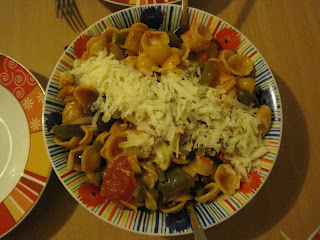
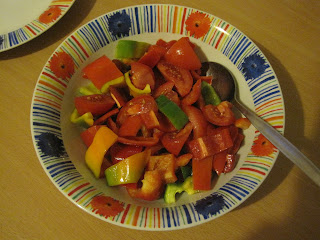
I am enjoying cooking dinner most nights as I find the ingredients are of much higher quality than I am able to buy at home (even the eggs are better - so yellow and so fresh that I think they are laid on the day we buy them). I haven't cooked anything that I wouldn't have made at home, but we think the meals have been very good. We've also been sampling some AMAZING cheeses, sausages and breads here in Padua; I've never seen such a variety of smallgoods as we have seen in the marketplace here. Photos of a couple of the dishes I've prepared, follow:

Last Friday I went to see the synagogue here, hoping to just pop in for a moment, take a look around and then leave. I realised that it was Succoth, a special holy day in our calendar but I didn't think that would make a difference. An hour and a half later I emerged, having stayed for the whole service and been plied with sweet cake and wine, as well as being invited back to come again as often as I can. There were only 18 in the whole congregation but everyone was SO nice to me that I felt very welcome and included from the moment I arrived, when I was given a prayer book and shown which passage they were up to; it was all lovely. To travel to the other side of the world and find your own people waiting for you is very heartwarming.
We have been blessed with wonderful weather since arriving, with temperatures around 20 degrees each day as well as clear blue skies most of the time. It can be chilly in the evening but we came prepared for that and manage perfectly well with an extra jacket and scarf when we walk after dinner. Last night we walked to the piazza and bought gelati around 8:00pm but we came back to the apartment to eat it, as there was a bit of a cool breeze blowing and it was easier to just head back home. Most afternoons we sit in the piazza and have a glass of wine while doing some people-watching before we have dinner. There is quite a sport of that going on here, it seems. Many couples and small groups seem to do the same as we do, perhaps on their way home from work. There is a fellow roasting chestnuts in the piazza late each afternoon and we usually choose a spot where we can watch him throwing the huge pan in the air and chatting with everyone who walks by.

Today we made a day trip to a little town called Este, which is about 30 minutes away by train. It is an historical town with a castle, and every third Sunday there is an antique market in the piazza, so we thought that might be fun. It was OK, but not as good as we expected. It doesn't matter, though, because when you have a month to do things, there will be some days that are better than others. Here's the obligatory photo of the castle in Este, anyway:

Incidentally, for the first time today since our journey began, I heard the "f-word" and not just once but about 87 times. It wasn't an Italian saying it. A group of young Australian boys boarded our train, apparently on their way to watch a rugby game (?) in Verona. They were loud and obnoxious and every sentence was punctuated with swearing and carry-on. We were not proud.
Is it wrong to say that we're missing TV? We have about 300 stations on our TV but none of them is English-speaking. Sometimes in the evening you just want to sit down and watch a movie, a documentary or any old thing, but it's not possible. I'm grateful for having the Kindle with me, as I've read four books in the past two weeks and am nearly finished with my fifth.
OK, enough from me for now. Hope all is well, wherever you are reading this.
D1
Thursday, 13 October 2011
A day in Venice for less than 25 euros
A relaxed day in Venice was had for the cost of two 2nd class return rail tickets from Padua, four pieces of fruit from the market, two sandwiches, a coffee and a bottle of fizzy water - all up cost just under 25 euros.
Venice today was much more enjoyable than our previous visit in 2009. Despite the fact that there were still significant numbers of tourists, we being among them, the crowds appeared to be less dense, and you could actually stroll down the myriad of narrow streets and laneways without feeling the pressure of having to move with the crowd. The visit was enhanced by the knowledge that we were not in a hurry; being only 25 minutes away by train we can go back to Venice any time.
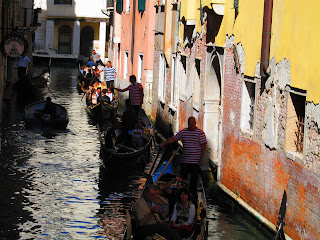
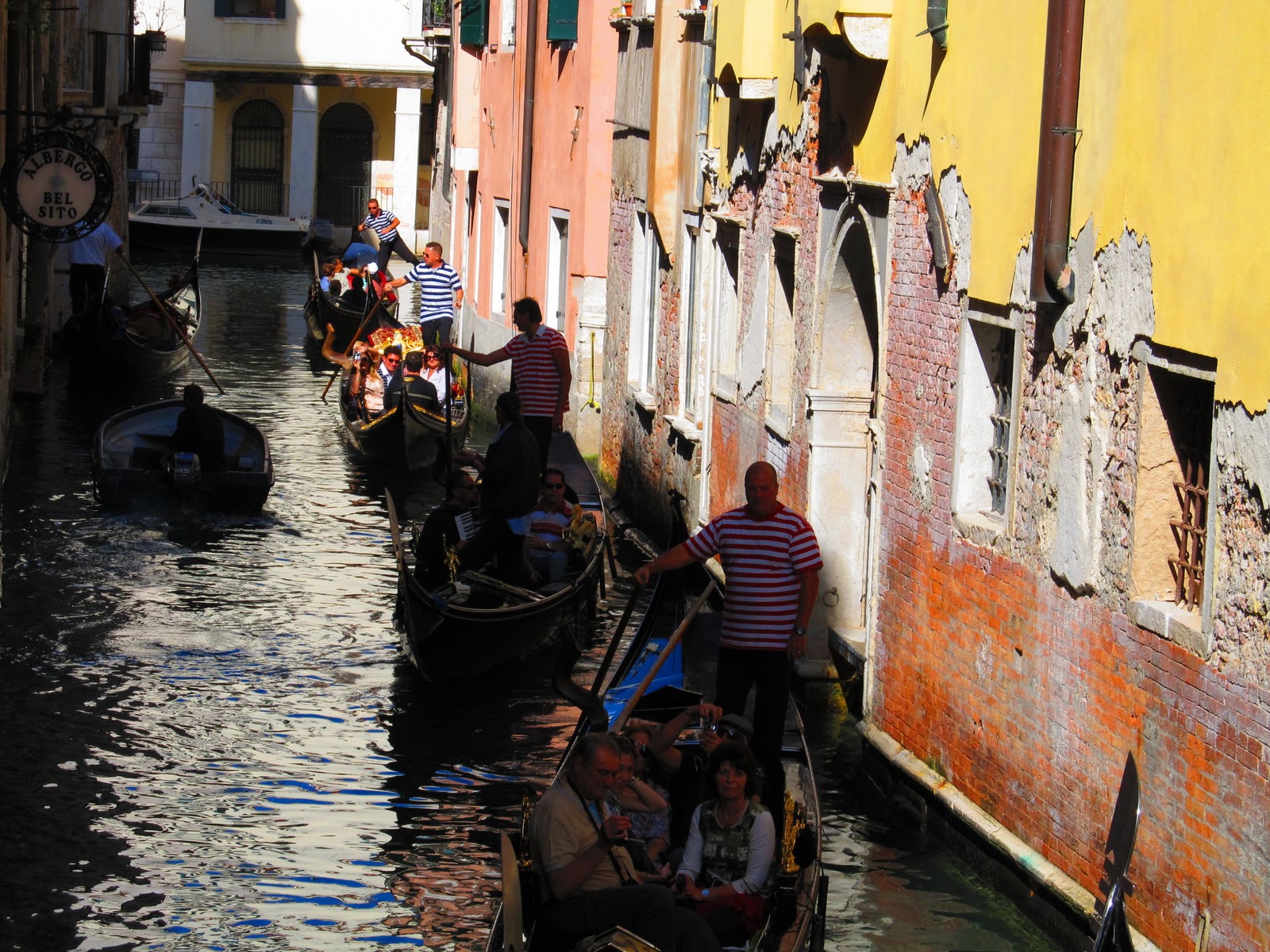
We did the predictable things - visited the fresh food market, followed the tinsel trail to St Marks Basilica, ate our lunch in the square, gawped at the endless array of famous buildings and monuments, mocked the tourists who had paid a small fortune to ride in a gondola, took lots of photos, tracked down the only two public toilets in all of Venice, drank coffee as life passed us by on the Grand Canal, and then caught the train back to Padua so that we could be home for cheese, biscuits and drinks by 4:00 pm. A good day - and the weather continues to be perfect.
D2


Venice today was much more enjoyable than our previous visit in 2009. Despite the fact that there were still significant numbers of tourists, we being among them, the crowds appeared to be less dense, and you could actually stroll down the myriad of narrow streets and laneways without feeling the pressure of having to move with the crowd. The visit was enhanced by the knowledge that we were not in a hurry; being only 25 minutes away by train we can go back to Venice any time.
We did the predictable things - visited the fresh food market, followed the tinsel trail to St Marks Basilica, ate our lunch in the square, gawped at the endless array of famous buildings and monuments, mocked the tourists who had paid a small fortune to ride in a gondola, took lots of photos, tracked down the only two public toilets in all of Venice, drank coffee as life passed us by on the Grand Canal, and then caught the train back to Padua so that we could be home for cheese, biscuits and drinks by 4:00 pm. A good day - and the weather continues to be perfect.
D2


Wednesday, 12 October 2011
Every picture tells a story
It will be difficult to choose the right words when describing our journey through the streets of Padua over the next few weeks, so I am just going to start with a few selected photos to avoid the overuse of adjectives like awesome, amazing and fantastic.
D2


D2


Ritual
I'm still reeling from the surprise that is Padua. It was so different in 2009 that I hardly recognise it now, except for the familiar sense that here in Padua all is well. It's a very surrounding and enveloping town, cosy like a warm blanket and welcoming like an old friend. Below are two photos taken looking each way down the street from the window of our apartment, early this morning.


A huge part of the community here is made up of university students, as Padua is an old university town - the University of Padova was founded in 1222. The young people provide colour and light to this old town and their laughter and joy is apparent. How could anyone be sad, in this town which offers so much?
It appears that today is graduation day for some of the students; further, it appears that there are some interesting rituals which take place on this special day. After the official ceremony, students parade down the main street to the piazza (public square), wearing a wreath of bright green laurel leaves and bells around their necks, so that everyone can easily identify the students out of the general throng.
On arrival, their friends and family form a kind of guard of honour for them and the student runs back and forth through this, while being slapped on the back. At this point, they are still wearing their graduation outfits, but soon thereafter the family surrounds the student and another set of clothing is dragged out for them to change into; this second outfit has been put together by their friends and might be a superhero costume, a great big nappy, funny hat or another strange costume of some kind (one boy we saw was dressed only in his jocks, with a beak on his face - more of this later...).
A pedestal is erected and the student must stand on it and recite a long funny poem about his life which has been written and transcribed onto a huge scroll along with a large caricature of the student, by his friends; in the meantime, the mates spray him with shaving lotion, pour water and flour on him, throw eggs at him, squirt tomato sauce or any of a number of other concoctions at him in order to distract him from the reading - if he makes a mistake while reading, or hesitates, he must take a swig of the(reasonably alcoholic) beverage which has been brought along for him. By the end of the poem, the student is generally covered head to toe in a mixture of all the things he or she has been sprayed with.


The aforementioned student wearing only jocks, was covered in something very sticky, followed by a pillow-ful (?) of feathers, so that he looked like a 6-foot chicken.

All of the swigging is of course accompanied by chanting and laughter and it's all great fun to watch. There might be a limbo stick or the local fountain to be contended with, too - all with great hilarity, of course! When it is over, the graduand is wiped down and tidied up enough to be able to put his proper clothes back on, then everyone goes off to a big celebratory meal elsewhere. The theory behind the ritual is that this is the fun part at the end of the studies and before the serious part of real life begins. Good theory.
D1
Subscribe to:
Posts (Atom)