Showing posts with label Orvieto. Show all posts
Monday, 5 December 2011
Saturday, 3 December 2011
Bella Musica - Beautiful Music
We have been very fortunate over the past two weeks to attend two free musical concerts in the beautiful Mancinelli Theatre here in Orvieto. The first was a piano recital in a private performance space within the building, where young students aged perhaps 15 - 20 years treated us to the results of their (presumably) hundreds of hours of practice each week. To sit in such ornate surroundings and listen to these highly accomplished young people was an absolute joy.
Last night we attended a completely different concert in the main part of the theatre. A brass band comprising 70 members of the Guardia di Finanza (a branch of the police force) performed on the central stage. The band is very well-known and well-regarded, having been formed in 1926 and played all over the world, from Abu Dhabi and Luxembourg to New York and Belgium, always to great acclaim. For us, it was another wonderful evening in Orvieto.
D1
Last night we attended a completely different concert in the main part of the theatre. A brass band comprising 70 members of the Guardia di Finanza (a branch of the police force) performed on the central stage. The band is very well-known and well-regarded, having been formed in 1926 and played all over the world, from Abu Dhabi and Luxembourg to New York and Belgium, always to great acclaim. For us, it was another wonderful evening in Orvieto.
D1
Friday, 2 December 2011
The Kindness of Strangers
I've mentioned in a previous blog that we sometimes frequent a particular bar for elevenses, which is run by a French chap and his girlfriend. When we first went there, the guy told us that there is an Australian lady who comes in all the time, and we will surely meet her one of these days.
With one thing and another, K returned to Perth having made a verbal agreement to buy the apartment and had a piece of paper in hand to show that she had paid a deposit and everything was in train for her to make the move to Orvieto permanently. Months passed, permits were issued, legal papers drawn up, etc etc and K has now lived happily here for about two years. All is swell.
After drinking coffee together and chatting amiably for an hour or so, K very kindly invited us to come to her home for dinner last night, an invitation which we greedily accepted in light of the fact that we were (a) so excited to talk to someone apart from each other, (b) we were so excited to speak English to someone apart from each other, (c) we wanted to see her apartment and of course (d) we are always hungry. K advised us that she had just bought a case of prosecco and had plenty of food, so we knew the pre-requisites were all there.
The apartment was absolutely gorgeous, very modern, bright and airy and with a magnificent view out to the surrounding patchworked Umbrian farmlands. We immediately made her an offer on it and she accepted ... just kidding, we really are coming home to Melbourne in the near future... *sob*
We grilled K on how it all works, this whole "buying property in Italy" thing, which is quite mysterious and interesting; it is also not material for this blog but it did get my heart racing just a little bit.
We dragged ourselves home after a wonderful (huge) meal and rather a lot of alcohol, thinking "Wow!" We are still reeling from the idea that a perfect stranger could so open-heartedly welcome us into her home and share so much with us, presumably never to see us again. I've decided that it's just an Italian thing. That's the way it is, here. People can be just nice, with no ulterior motive.
D1
Orvieto Brass Band
I know this is out of chronological order, but it's taken me until now to get around to uploading this little video to YouTube.
Last Sunday, we were strolling along after our morning coffee stop and could hear the sounds of a brass band playing. Ever intrigued by all things Italian, we headed in the direction of the music, to discover a small crowd gathered in the main piazza, watching a band of musicians, as it started to parade away from the piazza and down the main street towards the Duomo. Naturally, we wanted to be part of the fun, so we followed behind the group.
As the music was finishing, the priest appeared on the steps through the huge main double doors and gently shoo-ed people away from the entrance to the cathedral, so that the band could have unimpeded passage into the church wherein they were soon seated in pride of place at the front of the congregation. Clearly, they were the guests of honour. We don't know the significance of the particular occasion but we were pleased that we had been witness to it.
D1
Wednesday, 30 November 2011
Civita di Bagnoregio. Never heard of it? Neither had we.
It's simply impossible to ignore history when you are visiting Italy. At every turn, you are confronted with the wondrous past and you cannot take a single photograph which ignores the life of those who walked here before us. We have shunned anything modern and new that we have come across, over the past few weeks, and considered those to be aberrations in this place which is so steeped in what it once was. Our only concession to today's world is our need to connect to the damned internet - if only we could be without it, cursed and unreliable thing that it is. All this serves merely as an introduction to yesterday's adventure, in which your humble bloggers travelled back in time once more.
We have only a precious few days remaining here in Orvieto and the weather has been so kind to us that it seems a shame to remain indoors drinking coffee, eating pastries and reading, those being some of our favourite things to do, admittedly. I had been reading about a little town called Bagnoregio, which is pretty and old and despite having those features alone to recommend it, is more of a drawcard by virtue of its connection by footbridge to an even-smaller tiny wee village called Civita. The bus ride cost a mere two euros and took 55 minutes to its destination. We alighted in Bagnoregio and walked through the town and out the other side, to reach Civita.
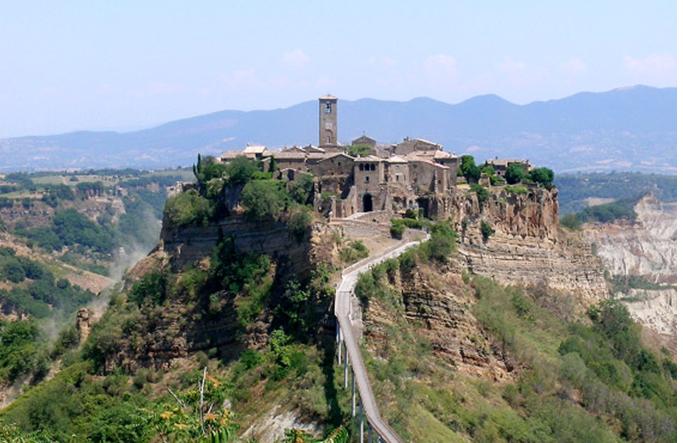
Unfortunately, our camera is inadequate to take a good photo of the approach to Civita from Bagnoregio, so I have included this shot from the internet which may have been taken from a helicopter of what has been called "the umbilical bridge that connects Civita with ... the rest of Italy."
Despite appearance, it is not snow that can be seen in the photo below of the valleys around the rock, but volcanic earth. How desolate and stark it looks.
We have only a precious few days remaining here in Orvieto and the weather has been so kind to us that it seems a shame to remain indoors drinking coffee, eating pastries and reading, those being some of our favourite things to do, admittedly. I had been reading about a little town called Bagnoregio, which is pretty and old and despite having those features alone to recommend it, is more of a drawcard by virtue of its connection by footbridge to an even-smaller tiny wee village called Civita. The bus ride cost a mere two euros and took 55 minutes to its destination. We alighted in Bagnoregio and walked through the town and out the other side, to reach Civita.
Unfortunately, our camera is inadequate to take a good photo of the approach to Civita from Bagnoregio, so I have included this shot from the internet which may have been taken from a helicopter of what has been called "the umbilical bridge that connects Civita with ... the rest of Italy."
Despite appearance, it is not snow that can be seen in the photo below of the valleys around the rock, but volcanic earth. How desolate and stark it looks.
Civita was founded way way back, in about 500 BC by the Etruscans on a volcanic outcrop and that rocky monolith is surrounded by stunningly picturesque valleys. Due to erosion, massive pieces of the volcanic tufa have fallen away from the main area over the centuries, leaving Civita as a virtual "island", now reachable only by the footbridge. It is known as a "dying city" because at some time in the future, the erosion will result in Civita's complete destruction, but in the meantime there are a few bars, art studios, a large church (of course) and various knick-knack shops; twice each year a festival called Palio della Tonno is held in the town, culminating in a donkey race in the main piazza. I'd love to see that.
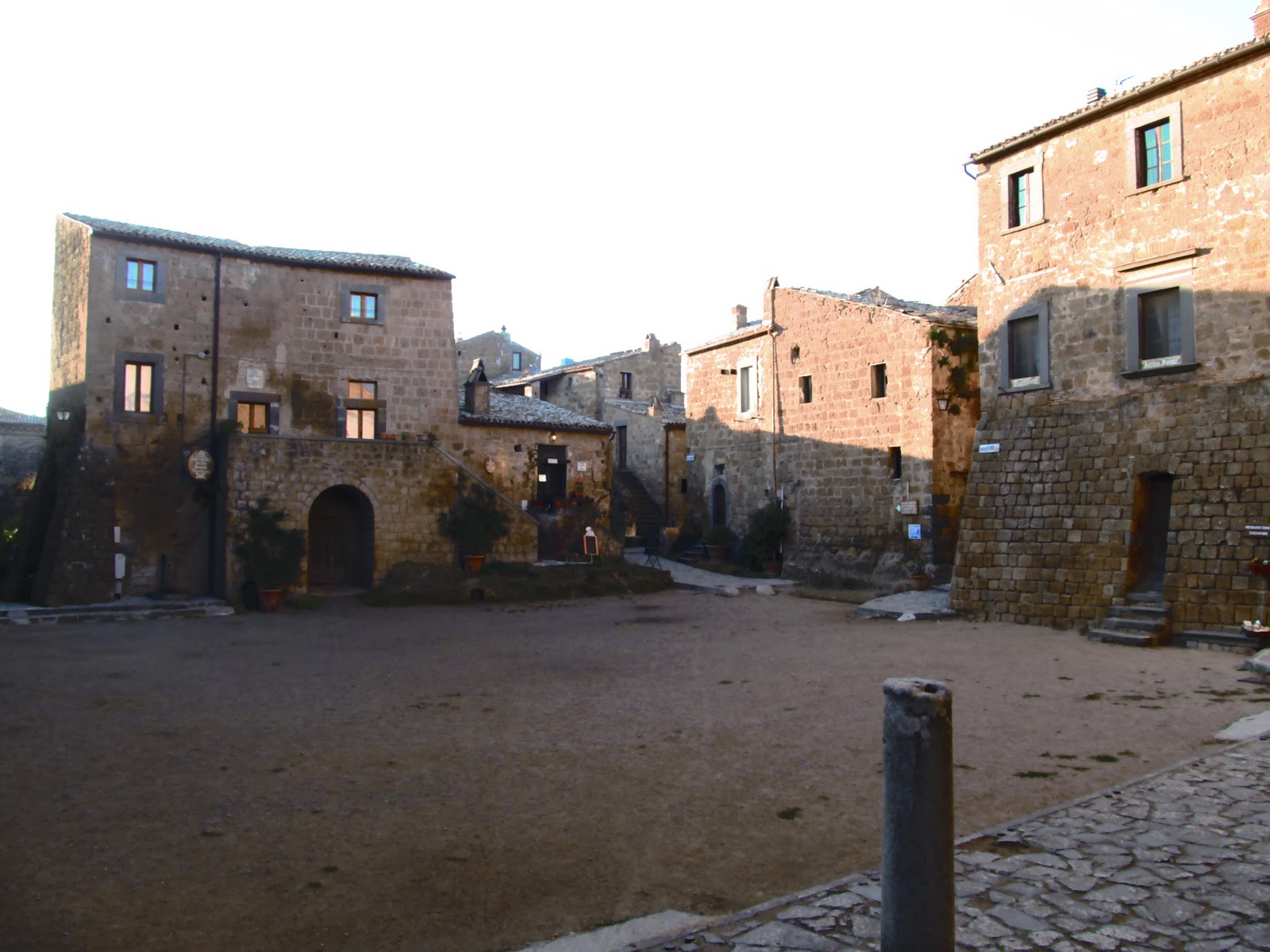
We heard different reports of how many people actually live in Civita, but regardless of which story you listen to, you can count the number of residents on your fingers and toes. Apparently, in the warmer months, a lot of tourists do visit, but when we were there yesterday there were only about 12 people visiting (including us) and as we drank our beer at an outdoor cafe, we waited for the tumbleweeds to roll through.
D1
We heard different reports of how many people actually live in Civita, but regardless of which story you listen to, you can count the number of residents on your fingers and toes. Apparently, in the warmer months, a lot of tourists do visit, but when we were there yesterday there were only about 12 people visiting (including us) and as we drank our beer at an outdoor cafe, we waited for the tumbleweeds to roll through.
D1
Sunday, 27 November 2011
From Lakeside to Hilltop
We have had a busy week visiting several towns in Umbria, the first few in a toy car which we hired from Hertz, and the last with the usual help from our friends at Trenitalia.
Bolsena. This small town shares its name with the beautiful lake upon the shore of which the town is found. Bolsena is about 20 kilometers from Orvieto, and the journey there on easily navigated roads is enhanced by the beautiful countryside which is alive with Autumn colour. As is to be expected with a car in a small Italian town, parking was always going to be the issue, but even that issue was solved after a few blind alleys and u-turns.
The coffee and pastries for elevenses were also a hit at only 3.60 euro (about AUD$5) for "due cappuccini e due brioche", our standard order. In Italy, when you order a "brioche" it can mean almost anything, as long as there is pastry involved - sometimes it is a plain croissant but other times it is a flaky pastry filled with jam, Nutella, custard cream or even sweet ricotta studded with dried fruit. The price is the same, regardless. You are offered a paper napkin and you can choose your own - most people stand at the bar and swiftly knock back a tiny espresso and a brioche, hand the cashier (almost always a separate person at a separate little counter) a couple of euros, then fly out the door with a "buon giornata" (have a good day) as they go.
The big attraction in Bolsena is the lake itself, the third largest in Italy apparently, and with a colour so blue it almost looks a little fake. The other notable attraction in the town is the huge Church of Saint Christina, dedicated to the young martyr of the same name.
Montefiascone. We arrived in this very small hilltop town within 20 minutes of leaving Bolsena, parked the car and found the elevator which took us most of the way to the main piazza, and then onwards and upwards until we found the doors of Cattedrale di Santa Margherita. Doors locked and more scaffolding than you can imagine, no signs on the door welcoming pilgrims from foreign lands, and no indication that it would be open anytime soon. So, down the hill we go through the main piazza all the way to the bottom of the hill to visit Basilica di San Flaviano, a quick look around, and then halfway up the hill again before we settle on a place for lunch.
Over lunch we had been assured that the Catherdral would in fact be open at 3:00 pm, and the meantime we should take in the views of the countryside from La Rocca dei Papi (The Papal Fortress), so, up the hill we go again. The views of the Umbrian countryside were indeed spectacular, as was this higher altitude view of Lake Bolsena, but alas, cometh the hours for the church doors to be thrown open, and ... nothing! So, down the hill we go, down the elevator, into the car, and off we go to Viterbo.
We arrive at the city limits of Viterbo as the afternoon traffic is starting to get heavy, the light is beginning to fade, the driver is getting cranky, and the navigator has thrown away her map. After 15 minutes of following the sign to Centro (indicating the city centre), and seeing nothing but traffic and the gradual illumination of street lights, we see a sign for Tuscany and promptly turn around and head north again hoping to find a turn off to Orvieto. Luck saves the day, the toy car is returned to Hertz after consuming just 7.00 euro worth of diesel, and we head up the hill again to Orvieto by furnicular, to the warmth of our apartment.
Perugia. On Saturday morning we arrive at Perugia rail station and immediately catch a local bus to the top of the hill (and it's quite a big hill). The decision is also made that we are only going to see what is at the top of the hill, none of this up-and-down stuff for us. The first thing that happens to us after cruising along the Corso Vanucchi and poking our heads inside the Cattedrale di La San Lorenzo is that we are invited to a wedding. Whilst lurking about on the steps of the adjacent Town Hall building, a smartly dressed woman sees us and in halting English explains that the building is closed for a private function, but we should come inside and watch. The private function turned out to be a wedding, with the city official all smartly dressed and with appropriate coloured sashes, whilst the groom was in jeans and a T-shirt which had a printed tie on the front - no doubt kept for all formal occasions. The bride (from Ecuador) wore a cream-colored coat dress and looked lovely. Deb and I even had our photos taken for their family album.
The remainder of the day was spent investigating lots of small side streets, eating a massive pizza lunch in an outdoor cafe as the sun (and the shadows) rapidly moved overhead, a browse at the outdoor antique bric-a-brac market taking place in a local park and then a look inside the fascinating Rocca Paolina, a fortress commissioned in 1540, partly destroyed in 1848, and re-built in 1860. The original fortress was constructed over five levels and today the remaining chambers and corridors are used for trade shows and small exhibitions and accessed by escalators from street level.
Down the hill we go on the bus and onto a waiting train for the homeward bound journey to Orvieto via Terontola, and I have deliberately inserted the photo of the station just to let you all know what the end of the world looks like.
D2
Bolsena. This small town shares its name with the beautiful lake upon the shore of which the town is found. Bolsena is about 20 kilometers from Orvieto, and the journey there on easily navigated roads is enhanced by the beautiful countryside which is alive with Autumn colour. As is to be expected with a car in a small Italian town, parking was always going to be the issue, but even that issue was solved after a few blind alleys and u-turns.
The coffee and pastries for elevenses were also a hit at only 3.60 euro (about AUD$5) for "due cappuccini e due brioche", our standard order. In Italy, when you order a "brioche" it can mean almost anything, as long as there is pastry involved - sometimes it is a plain croissant but other times it is a flaky pastry filled with jam, Nutella, custard cream or even sweet ricotta studded with dried fruit. The price is the same, regardless. You are offered a paper napkin and you can choose your own - most people stand at the bar and swiftly knock back a tiny espresso and a brioche, hand the cashier (almost always a separate person at a separate little counter) a couple of euros, then fly out the door with a "buon giornata" (have a good day) as they go.
The big attraction in Bolsena is the lake itself, the third largest in Italy apparently, and with a colour so blue it almost looks a little fake. The other notable attraction in the town is the huge Church of Saint Christina, dedicated to the young martyr of the same name.
Montefiascone. We arrived in this very small hilltop town within 20 minutes of leaving Bolsena, parked the car and found the elevator which took us most of the way to the main piazza, and then onwards and upwards until we found the doors of Cattedrale di Santa Margherita. Doors locked and more scaffolding than you can imagine, no signs on the door welcoming pilgrims from foreign lands, and no indication that it would be open anytime soon. So, down the hill we go through the main piazza all the way to the bottom of the hill to visit Basilica di San Flaviano, a quick look around, and then halfway up the hill again before we settle on a place for lunch.
Over lunch we had been assured that the Catherdral would in fact be open at 3:00 pm, and the meantime we should take in the views of the countryside from La Rocca dei Papi (The Papal Fortress), so, up the hill we go again. The views of the Umbrian countryside were indeed spectacular, as was this higher altitude view of Lake Bolsena, but alas, cometh the hours for the church doors to be thrown open, and ... nothing! So, down the hill we go, down the elevator, into the car, and off we go to Viterbo.
We arrive at the city limits of Viterbo as the afternoon traffic is starting to get heavy, the light is beginning to fade, the driver is getting cranky, and the navigator has thrown away her map. After 15 minutes of following the sign to Centro (indicating the city centre), and seeing nothing but traffic and the gradual illumination of street lights, we see a sign for Tuscany and promptly turn around and head north again hoping to find a turn off to Orvieto. Luck saves the day, the toy car is returned to Hertz after consuming just 7.00 euro worth of diesel, and we head up the hill again to Orvieto by furnicular, to the warmth of our apartment.
Perugia. On Saturday morning we arrive at Perugia rail station and immediately catch a local bus to the top of the hill (and it's quite a big hill). The decision is also made that we are only going to see what is at the top of the hill, none of this up-and-down stuff for us. The first thing that happens to us after cruising along the Corso Vanucchi and poking our heads inside the Cattedrale di La San Lorenzo is that we are invited to a wedding. Whilst lurking about on the steps of the adjacent Town Hall building, a smartly dressed woman sees us and in halting English explains that the building is closed for a private function, but we should come inside and watch. The private function turned out to be a wedding, with the city official all smartly dressed and with appropriate coloured sashes, whilst the groom was in jeans and a T-shirt which had a printed tie on the front - no doubt kept for all formal occasions. The bride (from Ecuador) wore a cream-colored coat dress and looked lovely. Deb and I even had our photos taken for their family album.
The remainder of the day was spent investigating lots of small side streets, eating a massive pizza lunch in an outdoor cafe as the sun (and the shadows) rapidly moved overhead, a browse at the outdoor antique bric-a-brac market taking place in a local park and then a look inside the fascinating Rocca Paolina, a fortress commissioned in 1540, partly destroyed in 1848, and re-built in 1860. The original fortress was constructed over five levels and today the remaining chambers and corridors are used for trade shows and small exhibitions and accessed by escalators from street level.
Down the hill we go on the bus and onto a waiting train for the homeward bound journey to Orvieto via Terontola, and I have deliberately inserted the photo of the station just to let you all know what the end of the world looks like.
D2
Wednesday, 23 November 2011
What Nothing Looks Like, in Orvieto
We've been doing quite a lot of that "nothing" I mentioned in a previous post - just walking about, looking at things, soaking it up, resting when the mood strikes and eating simply.
To use a religious analogy, it has been some days since our last confession, so this post serves only as confirmation that we haven't fallen off the perch and to share with you some of the deliciousness that is Orvieto.
We've walked around the village a bit over the past few days; it's very pretty, as you can see.
D1
To use a religious analogy, it has been some days since our last confession, so this post serves only as confirmation that we haven't fallen off the perch and to share with you some of the deliciousness that is Orvieto.
| Close-up shot of the counter of a little place where we like to enjoy the occasional plate of fresh cheeses and a glass of red to wash them down. |
| This is a wonderful local cheese called Burrata - it comes wrapped in its own little parcel tied with twine and unwraps to reveal a moist parcel of soft white cheese. The outside is similar to mozzarella, while the inside is melt-in-the-mouth creaminess. |
D1
Saturday, 19 November 2011
What Lies Beneath
Orvieto is not just beautiful and interesting at street level. Its underworld is a labyrinth of more than 1200 caves, passageways, tunnels, wells, stairs, cellars, niches and unexpected twists and turns, dug over several centuries out of the soft volcanic rock called tufa on which the ancient town of Orvieto sits. Almost every building visible on the street, has a cave underneath it – these were used as a means of escape when the ancient city was under siege but were also workrooms where olive oil was pressed, cloth was created on looms, wool was softened in a complex process, waterways were re-directed to channel rainwater down from rooftops to provide a water supply if the people were under siege, ceramic pottery (majolica) was made and glazed in massive underground kilns and pigeons were cultivated for food.
To stand in these caves and try to visualise the Etruscans tunnelling underground several centuries B.C. to create these very precisely cut rectangular wells (with foot-and-handholds each side for climbing) and peaked ceilinged caverns is quite staggering. Clearly they possessed exceptional engineering skill and considerable vision.
We visited two of the caves which are open to the public and were absolutely fascinated by their story. Apparently many of the residents currently living here make use of their own “personal” caves under their homes for the storage of their wine, as the temperature is consistent, throughout the year.
The walls of several sections of the cave we stood in yesterday are pocked with a perfectly arranged grid of hundreds of square holes where pigeons were raised – a small window-space opening allowed these homing pigeons to fly out for food and return to their nests as required. The baby pigeons were a valuable source of food for the residents at that time and still today in Orvieto restaurants, baked or roasted pigeon features on menus.
The final section of the tour took us to a large empty room, around which a low stone bench hugged the walls. This area was apparently used as a bomb shelter during WWll, and the research I did after arriving back at the apartment evidences that although Orvieto itself was relatively safe from attack at that time, the valley below was often the target of both the Allies and the retreating Germans because of its network of roadways and train lines. It must have been so frightening to sit in that underground cave, hearing the sounds of explosions outside and perhaps watching stones and rocks falling from the walls and ceilings.
The Pozzo della Cava (Cave Well) which we saw today was re-discovered very recently, in 1984, despite having been dug in the mid 16th century. In 1996 this 36-metre deep well was emptied of all the debris which had accumulated over the centuries, including a vast array of pottery, tools, primitive machinery and human skeletal remains, all of which were finds of considerable archaeological significance.
We then walked on to explore another area below the cliff face which is the site of an orderly arrangement of Etruscan tombs.
D1
Subscribe to:
Posts (Atom)