1. Never pass up the opportunity to use a public toilet, regardless of its condition - you just don't know where the next one will be.
2. There is no such thing as a bad coffee - espresso, cappuccino, latte - all great, no matter where you go.
3. The train system is cheap and there are trains to almost everywhere, except when there are snap strikes, and then the system sucks.
4. Cakes and pastries of all shapes and sizes are great to eat, and very inexpensive. They are rarely plain, being usually filled with jam, chocolate, creamy custard, fruit or other nice things.
5. A lot of people smoke and the cigarette butts all end up on the streets.
6. There are lots of dogs, mostly small cute things that would make a good entree for a bull terrier, but there is hardly any evidence of dog poo - their owners are obviously very disciplined.
7. Fruit, vegetables, cheese and smallgoods are plentiful and much cheaper than in Melbourne, and the quality and freshness is outstanding.
8. It helps enormously to try and use the few words of Italian that you know. Local people really appreciate your effort, even if it's only per favore and grazie.
9. You can't walk down any street without being accosted by someone trying to beg some money from you, or sell you something you don't want - bunches of roses, packets of tissues and so on.
10. The sky seems to be always blue.
11. There are so many basilicas, duomos, cathedrals and churches, and after several weeks of looking, it's hard to remember one from another.
12. Men are much more sociable and not reluctant to show affection towards each other - they gather in groups everywhere, chatting, laughing and gesticulating.
13. People love to gesticulate.
D2
Friday, 21 October 2011

Thursday, 20 October 2011
Adventure in Italian - Part 2
I planned to cook fish tonight, but wasn't sure what type of fish is local to the Mediterranean in general and around these parts in particular (Adriatic fish types, anyone?). So, I thought I had better do a bit of research before I went to the fish market this morning.
This research revealed that sole, flounder and sea perch were commonly eaten in this area. My next task was to discover the Italian words for each of those, so that I would recognise them by their name tags at the market. Easy? No.
The Google translator does not know what I mean by sole, of course, and thinks I am looking for the word which is a synonym of "only" - it brings up "unico" which I recognise straight away as not being the word I am seeking. Several frustrating web pages later and I am none the wiser, so I decide that I should go shopping for flounder instead. Ah hah, you say. There's a problem right there. You're right. I am not looking for the word which is a synonym for "struggle or thrash about" and I am worried that the word that Google throws up (passera) might be the one I don't want and the fishmonger might think (quite rightly) that I am an imbecile. So my last option is to find the Italian word for "sea perch". Forget it. I do not wish to perch by the sea. Not at all.
I walk to the market, thinking I will just point to the salmon and be done with it, because at least I am sure that I know what a salmon fillet looks like. Trouble is that I was planning on getting a white fish because I want to bake it in the oven with a piquant sauce. Never mind; plans are made to be broken.
When I saw the display of fish, I knew straight away that I wanted the one with the tag saying "pescatrice" because it looked just right. Having purchased it, I came home and looked it up to discover that it was monk fish. He's an ugly fellow, that's for sure, but he tasted great.
D1
This research revealed that sole, flounder and sea perch were commonly eaten in this area. My next task was to discover the Italian words for each of those, so that I would recognise them by their name tags at the market. Easy? No.
The Google translator does not know what I mean by sole, of course, and thinks I am looking for the word which is a synonym of "only" - it brings up "unico" which I recognise straight away as not being the word I am seeking. Several frustrating web pages later and I am none the wiser, so I decide that I should go shopping for flounder instead. Ah hah, you say. There's a problem right there. You're right. I am not looking for the word which is a synonym for "struggle or thrash about" and I am worried that the word that Google throws up (passera) might be the one I don't want and the fishmonger might think (quite rightly) that I am an imbecile. So my last option is to find the Italian word for "sea perch". Forget it. I do not wish to perch by the sea. Not at all.
I walk to the market, thinking I will just point to the salmon and be done with it, because at least I am sure that I know what a salmon fillet looks like. Trouble is that I was planning on getting a white fish because I want to bake it in the oven with a piquant sauce. Never mind; plans are made to be broken.
When I saw the display of fish, I knew straight away that I wanted the one with the tag saying "pescatrice" because it looked just right. Having purchased it, I came home and looked it up to discover that it was monk fish. He's an ugly fellow, that's for sure, but he tasted great.
D1
La Finestra - The Window
The night before last we thought it was high time that we tried one of the local restaurants that we had heard about, called La Finestra. It's situated very close to our apartment (as is just about everything; we are very centrally located) so it is no problem to walk there in the evening. Like most Europeans, the Italians eat dinner quite late, generally after they have had a little drink and snack on the way home from work, with friends or colleagues (a very delightful institution, I might add). We had returned around 6:30pm from Venice and needed to rest a bit, freshen up and change clothes before we headed off, so it was about 8:30pm by the time we wandered in to La Finestra.
Thankfully, it was a quiet night and there was a table available without a reservation being necessary. Most Italians, I think it is true to say, eat their main meal at home unless they are celebrating a special occasion or perhaps on a Sunday at lunchtime, when they might go to a restaurant with family. Consequently, restaurants are quite dependent on the tourist trade or at least on visitors from out of town. As we've mentioned before, Padua is not really on the tourist trail, an enormously favourable feature of the town as far as we are concerned, so we don't see here the kind of traffic of other places, and we are not constantly fighting the kind of touting that we have experienced in larger cities where restaurant owners try to coax you into their establishments as you pass by, and offer menus which contain dishes which tourists expect to find.
La Finestra is a small family-owned establishment, run by a husband and wife who really know their stuff. The table linen was of a beautiful embossed fabric, the crockery, glassware and cutlery of the highest quality and the service exemplary. The walls are interestingly decorated with take-offs of Magritte paintings, not presented in regular frames but in window frames, so that it appears you are looking through a window to these weird and wonderful visions outside. Quirky touch. I liked it a lot.
More to the point, the food was AMAZING. My entree was simply called "chicken salad" on the menu but turned out to be tiny jewels of chopped glace fruits, roasted pinenuts, moist morsels of diced chicken, baby green leaves of some description on a bed of wafer-thin scrapings of beetroot. It was absolutely divine. This photo does not do it justice, but I'm including it anyway:


Our hostess, Helene, was very interested in learning about why we were in Padua and shared with us some interesting insights into her hometown. She was really good company and we enjoyed chatting with her and thought it added to our evening in a way that you don't usually expect when dining in a restaurant. She even introduced us to the chef, her husband, whom we were quick to shower with praise about our delicious meals. The evening finished with a complimentary digestif of rosemary, lemongrass and "serious" alcohol. It was clearly a "home brew" and an unusual but delicious combination of flavours.
So, hence consequently therefore (as a dear departed friend used to say), if you are ever in Padua, don't even think about eating anywhere else.
D1
Thankfully, it was a quiet night and there was a table available without a reservation being necessary. Most Italians, I think it is true to say, eat their main meal at home unless they are celebrating a special occasion or perhaps on a Sunday at lunchtime, when they might go to a restaurant with family. Consequently, restaurants are quite dependent on the tourist trade or at least on visitors from out of town. As we've mentioned before, Padua is not really on the tourist trail, an enormously favourable feature of the town as far as we are concerned, so we don't see here the kind of traffic of other places, and we are not constantly fighting the kind of touting that we have experienced in larger cities where restaurant owners try to coax you into their establishments as you pass by, and offer menus which contain dishes which tourists expect to find.
La Finestra is a small family-owned establishment, run by a husband and wife who really know their stuff. The table linen was of a beautiful embossed fabric, the crockery, glassware and cutlery of the highest quality and the service exemplary. The walls are interestingly decorated with take-offs of Magritte paintings, not presented in regular frames but in window frames, so that it appears you are looking through a window to these weird and wonderful visions outside. Quirky touch. I liked it a lot.
More to the point, the food was AMAZING. My entree was simply called "chicken salad" on the menu but turned out to be tiny jewels of chopped glace fruits, roasted pinenuts, moist morsels of diced chicken, baby green leaves of some description on a bed of wafer-thin scrapings of beetroot. It was absolutely divine. This photo does not do it justice, but I'm including it anyway:

I had a pumpkin risotto for my main course. It was golden, sweet, flavoursome and delicious and I couldn't possibly finish it, firstly because of its richness and secondly because of the size of the serving.
Like most people I know that carob is used as a kind of chocolate substitute, usually eaten by people who can't tolerate chocolate. The dried carob bean, however, can be ground into flour and used in all sorts of savoury dishes which bear no relationship to chocolate at all. David chose "carob ravioli" as his starter and this (he said) was probably one of the best dishes he has eaten in a restaurant anywhere in the world (high praise, no?). The ravioli parcels were light and delicate, filled with soft ricotta and served with (wait for it...) a potato sauce. Now that doesn't even sound appealing, does it? It was, however, wonderful. I know, because I tried it.
David's main course was fresh grilled tuna served on a bed of caramelised onion and accompanied by roasted vegetables. He said it was exquisite. I believe him; it looked so. Once again, I include below a photo, but it doesn't do the dish justice.

Our hostess, Helene, was very interested in learning about why we were in Padua and shared with us some interesting insights into her hometown. She was really good company and we enjoyed chatting with her and thought it added to our evening in a way that you don't usually expect when dining in a restaurant. She even introduced us to the chef, her husband, whom we were quick to shower with praise about our delicious meals. The evening finished with a complimentary digestif of rosemary, lemongrass and "serious" alcohol. It was clearly a "home brew" and an unusual but delicious combination of flavours.
So, hence consequently therefore (as a dear departed friend used to say), if you are ever in Padua, don't even think about eating anywhere else.
D1
Adventure in Italian
A few days ago I decided that it was time to make the good old standard spaghetti bolognaise for dinner, so I ventured out to the meat market to buy mince. I knew that Italians don't have the same name for what we call bolognaise, and that the dish is known as "ragu", so I approached my chosen stall and pointed in the direction of the mince and asked in my limited Italian, "Questo per ragu?" meaning "Is this for (making) ragu?" to which the response was, "Si, signora."
My concern then was that perhaps it was minced pork rather than minced beef, but I couldn't recall the Italian word for beef, so I knew I would have to improvise.
"Moo?" I asked, timidly. The woman put her head to the side, raised an eyebrow and looked at me, quizzically. I realised that further explanation was necessary.
"No oink oink?" I said.
She laughed. "No, signora. Moo, moo!"
(The spag bol was delish, just btw).
D1

My concern then was that perhaps it was minced pork rather than minced beef, but I couldn't recall the Italian word for beef, so I knew I would have to improvise.
"Moo?" I asked, timidly. The woman put her head to the side, raised an eyebrow and looked at me, quizzically. I realised that further explanation was necessary.
"No oink oink?" I said.
She laughed. "No, signora. Moo, moo!"
(The spag bol was delish, just btw).
D1

Wednesday, 19 October 2011
Bo Palace: Anatomical Theatre
Padua University is the second oldest university in Italy, and the various faculties and campuses can be found all over the city. Of particular interest is the Faculty of Medicine where the original Anatomical Theatre can still be found in the Bo Palace, and only viewed from beneath as the structure is no longer safe enough to bear the weight of too many people.
The theatre was the first of its kind in Europe and consists of six elliptical tiers made of wood, with standing room for 300 students, all able to look down at the surgical action on the anatomical table below. The use of human corpses for such study was banned by Catholic Law at the time, so these procedures were done under conditions of great secrecy, and usually at night by torchlight. If there was a sudden threat of being "raided" by the police or authorities, the surgical table was able to be rotated to cause the human corpse to be hidden, and an animal cadaver revealed in its place. When the students and the professor had no further use for the bodies, they were taken into an adjoining room where they were boiled until all the flesh was stripped from the bones, and in this way a new batch of students was able to study the human skeletal structure. All very interesting.
Padua University is also famous for the fact that the first woman in the world to obtain a university degree graduated from here and there is a statue of her in one of the darkened alcoves. Given that the University was founded in 1222, it is interesting to note that it was not until 1678 that this event took place.
No photography allowed - attached photo of the Anatomical Theatre lifted from the internet.
D2

The theatre was the first of its kind in Europe and consists of six elliptical tiers made of wood, with standing room for 300 students, all able to look down at the surgical action on the anatomical table below. The use of human corpses for such study was banned by Catholic Law at the time, so these procedures were done under conditions of great secrecy, and usually at night by torchlight. If there was a sudden threat of being "raided" by the police or authorities, the surgical table was able to be rotated to cause the human corpse to be hidden, and an animal cadaver revealed in its place. When the students and the professor had no further use for the bodies, they were taken into an adjoining room where they were boiled until all the flesh was stripped from the bones, and in this way a new batch of students was able to study the human skeletal structure. All very interesting.
Padua University is also famous for the fact that the first woman in the world to obtain a university degree graduated from here and there is a statue of her in one of the darkened alcoves. Given that the University was founded in 1222, it is interesting to note that it was not until 1678 that this event took place.
No photography allowed - attached photo of the Anatomical Theatre lifted from the internet.
D2
Murano and Burano - art in glass and very fine lace
No trip to Venice would be complete without a visit to the islands of Murano and Burano, both of which are situated in the Venice lagoon, and both of which can be reached very easily by using the public ferry system. The ferries are not cheap when compared with local rail and bus travel, but in Venice there is no alternative to be had that affords a cheaper journey around the various places of interest.
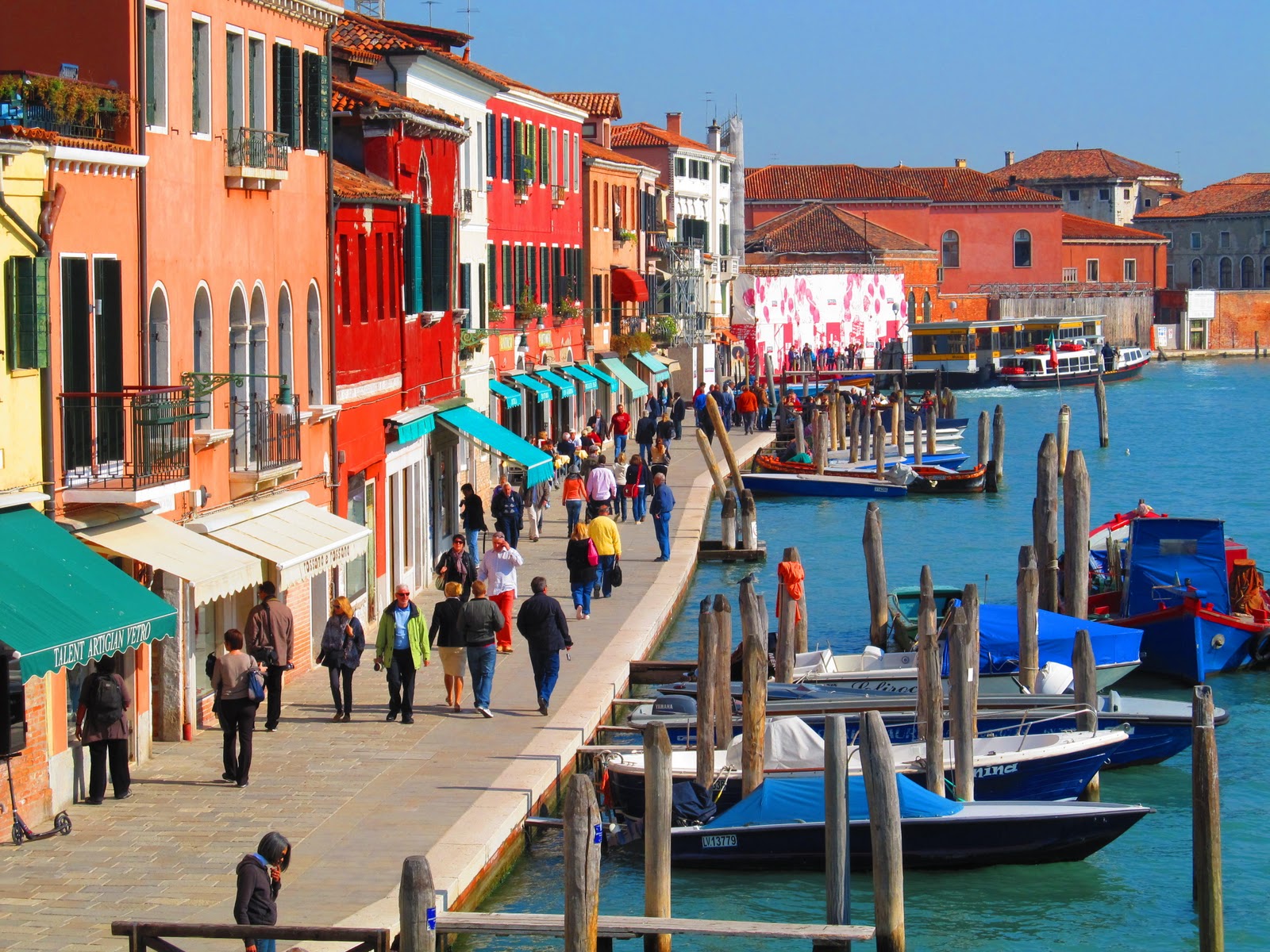
Murano is famous around the world for its glass. Everything here is "created" rather than made, everything comes from a "studio" rather than a factory, every piece is made by a "craftsman" rather than a worker, and yet amazingly, the same pieces appear in every second shop along the waterfront. And also amazing is the fact that when you do see a person making glass in a "fornace", he turns out to be a young man in overalls working in a factory. The island is very beautiful, the buildings all different heights, architecture and facades. There is also a much greater feeling of space when compared to Venice, and of course we were blessed with another fine day where the sky was painted in the brightest of blue colours.

The glass products have to be seen to be believed, as do the prices - everything from massive chandeliers, vases of every shape, size and colour , souvenirs and jewellery. The choice of product is overwhelming, and every piece comes with a "Certificate of Authentication", which broadly states that what you are buying is in fact made in Murano, and not imported from China.
The real pleasure of Murano is its difference from Venice, both in aspect and crowd density. Not everyone makes the journey from the main island of Venice, although those who do seem to be mainly US citizens from one of the several cruise liners that are seen to be in port. It's a great place to visit, and an even better place to move on from with all your money in your pocket.

Burano is a much smaller island, a further 20 minutes away, and it seemed there were at least 600 people crammed into the hull of the ferry taking us across, with no room to move and no fresh air. The first thing that struck us as we caught a glimpse of life above the waterline was that the buildings were painted in the most vivid colours imaginable. Legend has it that the fishermen who originally inhabited Burano applied the paint to their dwellings so that they could use it as a landmark on the homeward journey from the sea in situations where the fog was heavy, but we also have heard that the fishermen needed to be able to identify their own homes when they were returning from one too many alcoholic beverages. Not sure of the real story, but the houses are certainly brightly painted!

Burano is now best known for its fine lace items of clothing, tablecloths and bedspreads, and again I was on the lookout for the collection of old Nonnas, dressed in black and all hunched over their lace frames churning out products for those of us who come to visit. Not one Nonna in sight, but a multitude of shops with very extensive displays of products "all made by me in my own home" says one sales lady before we agree to pay her price for a very attractive tablecloth and 12 matching napkins.
There is also a plethora of restaurants in Burano, and the local specialties are all seafood and pasta. I watched in fascination as two Japanese tourists were cajoled into ordering spaghetti with squid ink, and was even more fascinated watching the expressions on their faces as they munched into it. They clearly did not like it - but hey, when in Burano...!

No small Italian village or island would be complete without a magnificent church, and Burano is no exception where the Church of St Martino Vescovo dominates the main piazza, complete with a tower that leans at a greater angle that the more famous offering in Pisa.
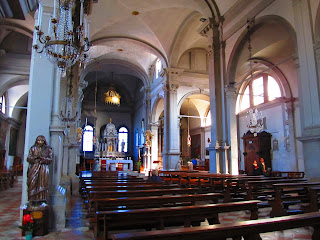
The return trip to Venice on the ferry was no less crowded, but we had managed to chain ourselves to the forward gangplank so that we could get a reasonable supply of fresh air. Whilst there we counted the heads on board and came to the happy conclusion that it is no worse than the 5.15 pm train to Frankston. We all survived.
D2
Murano is famous around the world for its glass. Everything here is "created" rather than made, everything comes from a "studio" rather than a factory, every piece is made by a "craftsman" rather than a worker, and yet amazingly, the same pieces appear in every second shop along the waterfront. And also amazing is the fact that when you do see a person making glass in a "fornace", he turns out to be a young man in overalls working in a factory. The island is very beautiful, the buildings all different heights, architecture and facades. There is also a much greater feeling of space when compared to Venice, and of course we were blessed with another fine day where the sky was painted in the brightest of blue colours.

The glass products have to be seen to be believed, as do the prices - everything from massive chandeliers, vases of every shape, size and colour , souvenirs and jewellery. The choice of product is overwhelming, and every piece comes with a "Certificate of Authentication", which broadly states that what you are buying is in fact made in Murano, and not imported from China.
The real pleasure of Murano is its difference from Venice, both in aspect and crowd density. Not everyone makes the journey from the main island of Venice, although those who do seem to be mainly US citizens from one of the several cruise liners that are seen to be in port. It's a great place to visit, and an even better place to move on from with all your money in your pocket.

Burano is a much smaller island, a further 20 minutes away, and it seemed there were at least 600 people crammed into the hull of the ferry taking us across, with no room to move and no fresh air. The first thing that struck us as we caught a glimpse of life above the waterline was that the buildings were painted in the most vivid colours imaginable. Legend has it that the fishermen who originally inhabited Burano applied the paint to their dwellings so that they could use it as a landmark on the homeward journey from the sea in situations where the fog was heavy, but we also have heard that the fishermen needed to be able to identify their own homes when they were returning from one too many alcoholic beverages. Not sure of the real story, but the houses are certainly brightly painted!


Burano is now best known for its fine lace items of clothing, tablecloths and bedspreads, and again I was on the lookout for the collection of old Nonnas, dressed in black and all hunched over their lace frames churning out products for those of us who come to visit. Not one Nonna in sight, but a multitude of shops with very extensive displays of products "all made by me in my own home" says one sales lady before we agree to pay her price for a very attractive tablecloth and 12 matching napkins.
There is also a plethora of restaurants in Burano, and the local specialties are all seafood and pasta. I watched in fascination as two Japanese tourists were cajoled into ordering spaghetti with squid ink, and was even more fascinated watching the expressions on their faces as they munched into it. They clearly did not like it - but hey, when in Burano...!

No small Italian village or island would be complete without a magnificent church, and Burano is no exception where the Church of St Martino Vescovo dominates the main piazza, complete with a tower that leans at a greater angle that the more famous offering in Pisa.

The return trip to Venice on the ferry was no less crowded, but we had managed to chain ourselves to the forward gangplank so that we could get a reasonable supply of fresh air. Whilst there we counted the heads on board and came to the happy conclusion that it is no worse than the 5.15 pm train to Frankston. We all survived.
D2

Tuesday, 18 October 2011
The heat is on
The law in Italy says that home heating sytems can't be turned on until 1 November each year, and that the temperature cannot exceed 21 degrees celsius. Here in the north of the country, the local governments can apply for variations, which are usually granted, and so Padua is allowed to turn on the heat from 15 October. Now, as the evening temperatures begin to fall, we can walk through the door into a lovely warm room and feel a new level of comfort.
Sunday, 16 October 2011
The Past Few Days
We are acutely aware that we haven't blogged for a few days, but it's not because we can't be bothered or there's nothing to write about. In fact we are having a wonderful time, just relaxing and taking it all in, which was always our intention on this trip. We never intended to rush around "doing stuff", and that's the beauty of it.
In the mornings we get up around 8:00 or 9:00am and if we feel like it, we eat breakfast here in the apartment, which generally comprises cereal, toast and tea, but quite often we go to one of the nearby cafes called Brek, which is so ridiculously good that we repeatedly wonder why we ever have breakfast at home. One euro (about $AUD1.34) at Brek will buy you a wonderful coffee (any kind you like) and a pastry - this pastry comes served hot, freshly baked and you can choose either: a plain croissant, a flaky pastry filled with Nutella, a croissant filled with custard, a plain donut, jam-filled donut or custard-filled donut or a muffin. So, one euro = one coffee + one pastry. Does it get any better than that?

There's always something going on in Padua. We are happy to walk around the different market stalls every day and buy this and that while observing the "theatre".


Sometimes there will be a guy playing the piano accordian, or a juggler or a balloon artist. This morning there was a brass band - we don't know what the celebration was, but the uniform was interesting, featuring feathered hats and much pomp and ceremony.

Last Friday I went to see the synagogue here, hoping to just pop in for a moment, take a look around and then leave. I realised that it was Succoth, a special holy day in our calendar but I didn't think that would make a difference. An hour and a half later I emerged, having stayed for the whole service and been plied with sweet cake and wine, as well as being invited back to come again as often as I can. There were only 18 in the whole congregation but everyone was SO nice to me that I felt very welcome and included from the moment I arrived, when I was given a prayer book and shown which passage they were up to; it was all lovely. To travel to the other side of the world and find your own people waiting for you is very heartwarming.
We have been blessed with wonderful weather since arriving, with temperatures around 20 degrees each day as well as clear blue skies most of the time. It can be chilly in the evening but we came prepared for that and manage perfectly well with an extra jacket and scarf when we walk after dinner. Last night we walked to the piazza and bought gelati around 8:00pm but we came back to the apartment to eat it, as there was a bit of a cool breeze blowing and it was easier to just head back home. Most afternoons we sit in the piazza and have a glass of wine while doing some people-watching before we have dinner. There is quite a sport of that going on here, it seems. Many couples and small groups seem to do the same as we do, perhaps on their way home from work. There is a fellow roasting chestnuts in the piazza late each afternoon and we usually choose a spot where we can watch him throwing the huge pan in the air and chatting with everyone who walks by.

Today we made a day trip to a little town called Este, which is about 30 minutes away by train. It is an historical town with a castle, and every third Sunday there is an antique market in the piazza, so we thought that might be fun. It was OK, but not as good as we expected. It doesn't matter, though, because when you have a month to do things, there will be some days that are better than others. Here's the obligatory photo of the castle in Este, anyway:

Incidentally, for the first time today since our journey began, I heard the "f-word" and not just once but about 87 times. It wasn't an Italian saying it. A group of young Australian boys boarded our train, apparently on their way to watch a rugby game (?) in Verona. They were loud and obnoxious and every sentence was punctuated with swearing and carry-on. We were not proud.
Is it wrong to say that we're missing TV? We have about 300 stations on our TV but none of them is English-speaking. Sometimes in the evening you just want to sit down and watch a movie, a documentary or any old thing, but it's not possible. I'm grateful for having the Kindle with me, as I've read four books in the past two weeks and am nearly finished with my fifth.
OK, enough from me for now. Hope all is well, wherever you are reading this.
D1
In the mornings we get up around 8:00 or 9:00am and if we feel like it, we eat breakfast here in the apartment, which generally comprises cereal, toast and tea, but quite often we go to one of the nearby cafes called Brek, which is so ridiculously good that we repeatedly wonder why we ever have breakfast at home. One euro (about $AUD1.34) at Brek will buy you a wonderful coffee (any kind you like) and a pastry - this pastry comes served hot, freshly baked and you can choose either: a plain croissant, a flaky pastry filled with Nutella, a croissant filled with custard, a plain donut, jam-filled donut or custard-filled donut or a muffin. So, one euro = one coffee + one pastry. Does it get any better than that?

There's always something going on in Padua. We are happy to walk around the different market stalls every day and buy this and that while observing the "theatre".


Sometimes there will be a guy playing the piano accordian, or a juggler or a balloon artist. This morning there was a brass band - we don't know what the celebration was, but the uniform was interesting, featuring feathered hats and much pomp and ceremony.

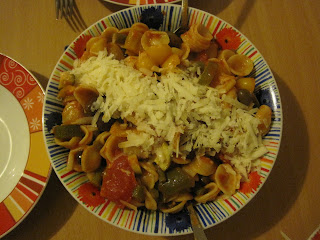
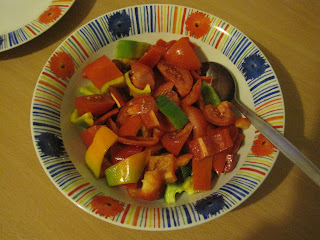
I am enjoying cooking dinner most nights as I find the ingredients are of much higher quality than I am able to buy at home (even the eggs are better - so yellow and so fresh that I think they are laid on the day we buy them). I haven't cooked anything that I wouldn't have made at home, but we think the meals have been very good. We've also been sampling some AMAZING cheeses, sausages and breads here in Padua; I've never seen such a variety of smallgoods as we have seen in the marketplace here. Photos of a couple of the dishes I've prepared, follow:

Last Friday I went to see the synagogue here, hoping to just pop in for a moment, take a look around and then leave. I realised that it was Succoth, a special holy day in our calendar but I didn't think that would make a difference. An hour and a half later I emerged, having stayed for the whole service and been plied with sweet cake and wine, as well as being invited back to come again as often as I can. There were only 18 in the whole congregation but everyone was SO nice to me that I felt very welcome and included from the moment I arrived, when I was given a prayer book and shown which passage they were up to; it was all lovely. To travel to the other side of the world and find your own people waiting for you is very heartwarming.
We have been blessed with wonderful weather since arriving, with temperatures around 20 degrees each day as well as clear blue skies most of the time. It can be chilly in the evening but we came prepared for that and manage perfectly well with an extra jacket and scarf when we walk after dinner. Last night we walked to the piazza and bought gelati around 8:00pm but we came back to the apartment to eat it, as there was a bit of a cool breeze blowing and it was easier to just head back home. Most afternoons we sit in the piazza and have a glass of wine while doing some people-watching before we have dinner. There is quite a sport of that going on here, it seems. Many couples and small groups seem to do the same as we do, perhaps on their way home from work. There is a fellow roasting chestnuts in the piazza late each afternoon and we usually choose a spot where we can watch him throwing the huge pan in the air and chatting with everyone who walks by.

Today we made a day trip to a little town called Este, which is about 30 minutes away by train. It is an historical town with a castle, and every third Sunday there is an antique market in the piazza, so we thought that might be fun. It was OK, but not as good as we expected. It doesn't matter, though, because when you have a month to do things, there will be some days that are better than others. Here's the obligatory photo of the castle in Este, anyway:

Incidentally, for the first time today since our journey began, I heard the "f-word" and not just once but about 87 times. It wasn't an Italian saying it. A group of young Australian boys boarded our train, apparently on their way to watch a rugby game (?) in Verona. They were loud and obnoxious and every sentence was punctuated with swearing and carry-on. We were not proud.
Is it wrong to say that we're missing TV? We have about 300 stations on our TV but none of them is English-speaking. Sometimes in the evening you just want to sit down and watch a movie, a documentary or any old thing, but it's not possible. I'm grateful for having the Kindle with me, as I've read four books in the past two weeks and am nearly finished with my fifth.
OK, enough from me for now. Hope all is well, wherever you are reading this.
D1
Thursday, 13 October 2011
A day in Venice for less than 25 euros
A relaxed day in Venice was had for the cost of two 2nd class return rail tickets from Padua, four pieces of fruit from the market, two sandwiches, a coffee and a bottle of fizzy water - all up cost just under 25 euros.
Venice today was much more enjoyable than our previous visit in 2009. Despite the fact that there were still significant numbers of tourists, we being among them, the crowds appeared to be less dense, and you could actually stroll down the myriad of narrow streets and laneways without feeling the pressure of having to move with the crowd. The visit was enhanced by the knowledge that we were not in a hurry; being only 25 minutes away by train we can go back to Venice any time.
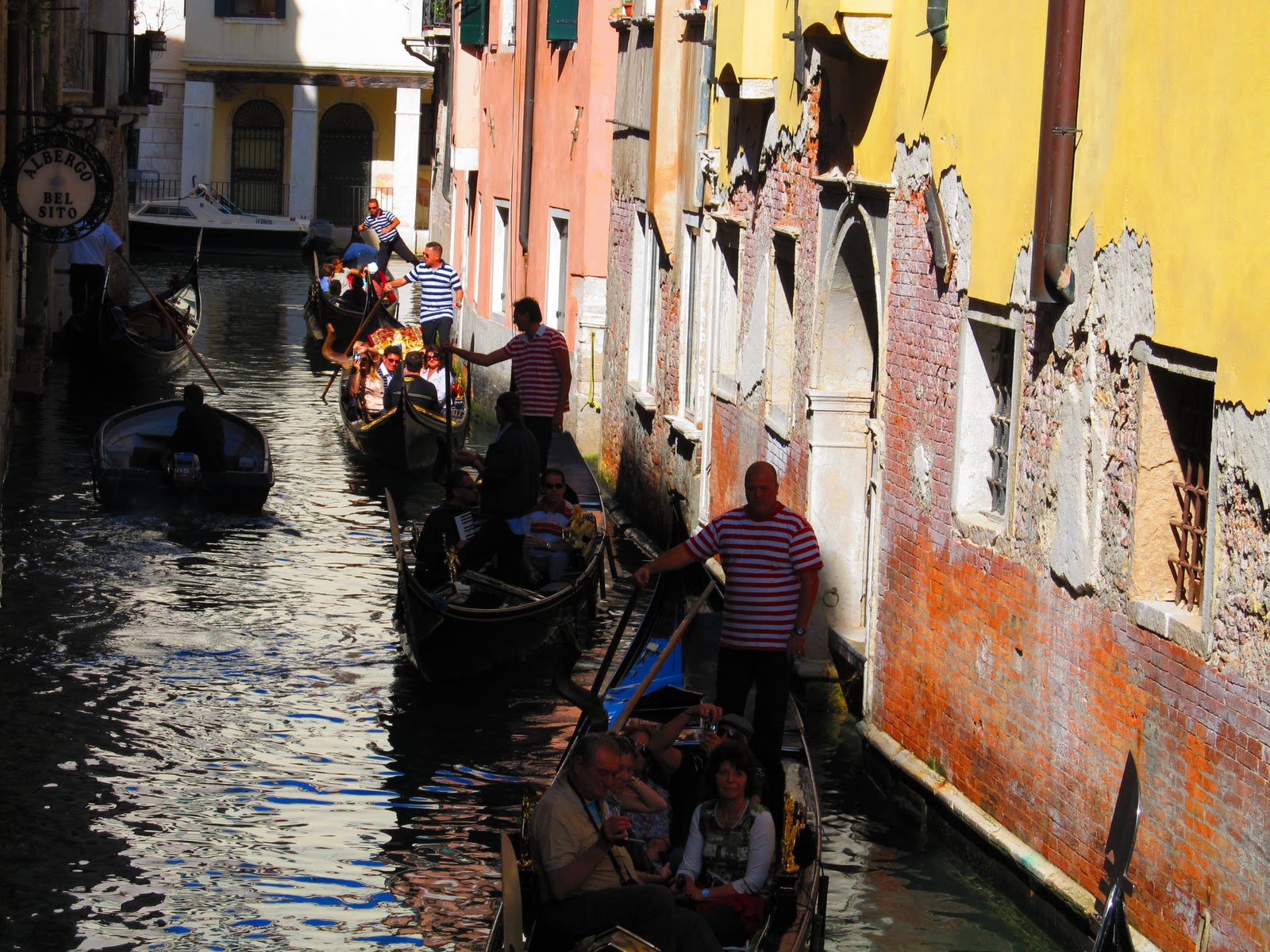
We did the predictable things - visited the fresh food market, followed the tinsel trail to St Marks Basilica, ate our lunch in the square, gawped at the endless array of famous buildings and monuments, mocked the tourists who had paid a small fortune to ride in a gondola, took lots of photos, tracked down the only two public toilets in all of Venice, drank coffee as life passed us by on the Grand Canal, and then caught the train back to Padua so that we could be home for cheese, biscuits and drinks by 4:00 pm. A good day - and the weather continues to be perfect.
D2


Venice today was much more enjoyable than our previous visit in 2009. Despite the fact that there were still significant numbers of tourists, we being among them, the crowds appeared to be less dense, and you could actually stroll down the myriad of narrow streets and laneways without feeling the pressure of having to move with the crowd. The visit was enhanced by the knowledge that we were not in a hurry; being only 25 minutes away by train we can go back to Venice any time.
We did the predictable things - visited the fresh food market, followed the tinsel trail to St Marks Basilica, ate our lunch in the square, gawped at the endless array of famous buildings and monuments, mocked the tourists who had paid a small fortune to ride in a gondola, took lots of photos, tracked down the only two public toilets in all of Venice, drank coffee as life passed us by on the Grand Canal, and then caught the train back to Padua so that we could be home for cheese, biscuits and drinks by 4:00 pm. A good day - and the weather continues to be perfect.
D2


Wednesday, 12 October 2011
Every picture tells a story
It will be difficult to choose the right words when describing our journey through the streets of Padua over the next few weeks, so I am just going to start with a few selected photos to avoid the overuse of adjectives like awesome, amazing and fantastic.
D2


D2


Subscribe to:
Posts (Atom)